
Not All ABA Is the Same: What Parents Should Know When Choosing Autism Care
If you’re exploring Autism care or ABA therapy for your child, you may suddenly find yourself learning a whole new language.
There are evaluations and recommendations to consider, new acronyms to learn, insurance questions to navigate, and decisions to make about people you may soon trust with someone you love more than anything.
It can feel like a lot.
And then you begin looking at ABA providers and find even more unfamiliar language. You may read about play-based ABA, naturalistic teaching, child-led learning, parent coaching, developmental approaches, or NDBI and wonder what all of it means, and, most importantly, what it will actually mean for your child.
But before all of those decisions, there is your child.
The little person you already know so well. The things that make them laugh. The interests they return to again and again. The ways they communicate, connect, explore, and experience the world. The strengths you see and all the things they are still discovering.
All of those wonderful parts of who your child is matter. And they can be the very places where meaningful learning begins.
That’s one of the things we most want families to know when they begin exploring ABA: there are many ways the science of learning can come to life in a child’s care.
ABA, or Applied Behavior Analysis, gives us a powerful science for understanding how learning happens. How we bring that science to life is shaped by our understanding of the individual child, their development, strengths, interests, relationships, family, and the environments where they live, play, and grow.
At Elevated Kids, we’ve spent years thinking deeply about one question:
What can evidence-based ABA look and feel like when we begin with the child?
For us, the answer begins with something beautifully simple.
For Young Children, Play Is the Way
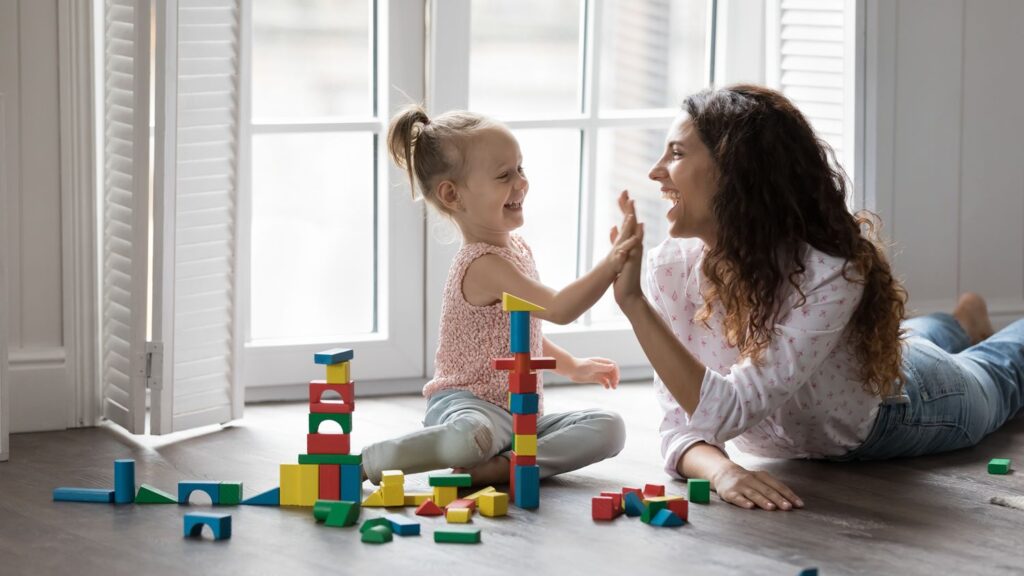
Young children learn through play.
They learn through relationships, movement, exploration, communication, curiosity, shared experiences, and the wonderfully ordinary routines that make up their days.
Play isn’t something children do when the learning is finished.
Play is one of the most important ways learning happens.
So much can be happening while a child builds a tower, chases bubbles, sings a favorite song, plays peekaboo, pushes a car back and forth, pretends to feed a stuffed animal, or asks for another push on the swing.
They may be communicating.
Imitating.
Problem-solving.
Sharing attention.
Connecting with another person.
Discovering new ways to play.
Learning that their communication can have an effect on the world around them.
And experiencing the joy and wonder of discovering something new.
All of this is learning.
And it reflects what we know about how young children develop. Play, relationships, exploration, and joyful engagement are central to early learning, and NDBI brings learning into those natural experiences.
For young children, play is the way.
Bringing Developmental and Behavioral Science Together
Behavioral science helps us understand how children learn.
Developmental science helps us understand how children grow and develop.
And a neurodiversity-affirming framework guides how we bring that science to each individual child, beginning with honoring them for exactly who they are.
At Elevated Kids, these ideas belong together.
ABA gives us a powerful science of learning. Developmental science helps us understand how learning unfolds within the context of a child’s development: through relationships, communication, play, movement, exploration, and everyday experiences.
NDBI brings developmental and behavioral science together. At Elevated Kids, our NDBI approach draws from shared evidence-based principles and strategies across established NDBI models and thoughtfully individualizes them around the child in front of us.
Every child has their own strengths, interests, preferences, ways of communicating and connecting, things that bring them joy, and ways of experiencing the world.
We take the time to understand that individual child and let that understanding guide how we support them.
That means building on strengths and interests. Listening to communication in all its forms. Respecting choices, preferences, and boundaries. Supporting regulation and self-advocacy. And choosing goals because they can make a meaningful difference in that child’s life.
We believe children can learn and grow while being fully honored for who they are. Meaningful progress builds from there.
Bringing all of this together shapes more than what we teach. It shapes how we understand the child, how we create opportunities for learning, and how we respond from one moment to the next.
It influences how we observe.
How we join a child’s play.
How we follow their interests and curiosity.
How we recognize and respond to all the ways they communicate.
How we create meaningful opportunities for learning within the things they already love to do.
How we support regulation, engagement, connection, and relationships.
How we individualize goals based on the child’s development, strengths, needs, and priorities.
And how we notice what a child is showing us and adjust our approach along the way.
We begin by getting to know the child in front of us: their strengths, interests, joys, ways of communicating, relationships, and where they are developmentally.
We meet children right where they are, honor them just as they are, and support their growth from there.
Child-Led + Clinician-Intentional
Being child-led and being intentional about learning can beautifully coexist.
During something that may look, from the outside, like ordinary play, a skilled clinician is paying close attention, not only to a child’s individualized goals, but to the child themselves.
What are they interested in?
What are they communicating?
What are they trying to figure out?
When are they inviting us in?
When might they need a little more time or space?
And where might there be a natural opportunity to help something new grow?
A clinician might join a child who is lining up favorite animals, pause during a familiar song, follow their excitement toward the bubbles, or wait just a little longer during a playful routine to create space for communication.
The play is genuinely child-led, and there is thoughtful clinical intention woven throughout it.
Clinicians are observing carefully, responding to communication in all its forms, building on the engagement and connection already happening, and adjusting what they do based on what the child shows them.
Sometimes that means adding a new idea, expanding the play, or creating an opportunity for communication or problem-solving. Other times, it means waiting, following the child’s lead, or simply staying connected and keeping a joyful interaction going.
The child’s interests, communication, choices, and responses help shape the interaction, while the clinician brings knowledge of development, learning, and the child’s individualized goals to each moment.
That’s what we mean by child-led + clinician-intentional.
The child helps show us the way. Our clinical expertise helps us know how to support the learning and growth that can happen along the way.
Learning Where Real Life Happens
A young child’s world is full of opportunities to learn, connect, explore, and grow.
They happen at home. At preschool and daycare. On the playground. In the grocery store. On a Target run. At swim class. With siblings. During breakfast, bath time, getting dressed, heading out the door, and all of the beautifully ordinary moments that make up childhood.
That’s where real life happens.
And it’s where so much meaningful learning happens, too.
At Elevated Kids, we provide ABA/NDBI therapy in children’s homes, preschools, daycares, and communities because we want learning to be connected to the people, places, relationships, and routines that already matter in a child’s life.
A favorite swing can become a joyful opportunity for communication and connection.
Getting dressed can support growing independence.
Playing with a sibling can nurture communication, connection, and shared play.
Snack time can create opportunities to make choices and communicate preferences.
A trip to the playground can invite movement, exploration, participation, flexibility, and social connection.
These may look like ordinary moments of childhood. But there is so much learning happening within them.
And when learning happens within meaningful experiences, children have opportunities to use their growing skills for something that matters to them: communicating what they want, participating in a family routine, connecting with someone they love, exploring somewhere new, or becoming a little more independent.
We want what children are learning to make a meaningful difference in their everyday lives.
That’s one of the things we love most about naturalistic, developmental-behavioral care.
Meaningful opportunities for learning are already woven throughout a child’s natural day, in their relationships, routines, interests, play, and experiences.
Life itself is full of opportunities for learning.
Connection Is at the Heart of Learning
To support a child well, we want to truly know them.
What makes them laugh?
What captures their curiosity?
What do they seek out again and again?
How do they communicate that they want more?
How do they tell us no, not now, or I’m finished?
What do they already do beautifully?
What helps them feel comfortable enough to explore something new?
What brings them joy?
And what does connection look like for this particular child?
At Elevated Kids, connection is woven into the way we play, learn, communicate, and grow together.
Connection isn’t separate from learning. It helps create the conditions where meaningful learning can happen.
And that can look different for every child.
It might grow through a silly song, a game of chase, a favorite book, bubbles, jumping together, or sharing an interest. Sometimes it begins simply by being nearby, noticing what a child loves, following their lead, and giving them the time and space to invite us in.
We meet children there.
When we take the time to know a child, to understand their interests, recognize their communication, notice what brings them joy, and learn what connection looks like for them, we can build meaningful learning from those shared moments.
To do that well, we need to know more than a child’s goals.
We have to know the child.
Parents Are the Experts on Their Children
To truly know a child, we have to listen to the people who know them best.
Parents and caregivers are the experts on their children.
As clinicians, we bring knowledge and experience in learning, behavior, development, and Autism care.
And families bring something equally important:
You know your child.
You know the little things that make them light up.
You know the looks and gestures other people might miss.
You know what mornings are really like.
You know the routines they love at bedtime.
You know what they could happily do again and again.
You know what feels hard.
You know what comforts them.
And you know those moments when you think, I wish I knew how to help here.
The best care brings both kinds of knowledge together.
That’s how we think about parent coaching at Elevated Kids: as a partnership.
We listen. We learn from you. We share what we’re noticing. We celebrate what’s going well. We problem-solve together when something feels hard. We help make sense of the why behind what we’re doing and think together about what might be helpful within your family’s actual routines, priorities, preferences, and life.
Because what works for one child or one family may look completely different for another.
And through all of it, parents get to be parents.
You’re Mom. Dad. Grandma. Grandpa. Caregiver.
Those relationships are precious. They’re filled with love, comfort, play, connection, traditions, ordinary moments, and memories that extend far beyond any therapy goal.
Our role is to come alongside your family, to support you, share what we know, learn from what you know, and help create more opportunities for communication, connection, independence, play, and participation within the life you’re already living together.
We’re all in this together. And it’s truly an honor to get to know your child and support your family along the way.
What Can Meaningful Learning Look Like?
Imagine we’re supporting a child in communicating that they want more of something they love.
Maybe this particular child absolutely loves being pushed on a swing.
We get ready to push the swing, sharing in the anticipation and excitement:
“Ready…”
“Set…”
And then we wait.
The child might look toward us, reach, gesture, sign, use a communication device, make a sound, say a word, or communicate “Go!” in another meaningful way.
We notice. We respond. And the swing moves.
Something important just happened.
Their communication meant something. It was heard, understood, and changed what happened next.
And all of it happened within a joyful moment of play and connection.
Over time, moments like this can help a child discover just how powerful their communication can be. They can build on the ways they already communicate while developing new ways to share what they want, need, think, feel, and choose.
That’s what meaningful learning can look like.
It can happen in the middle of something a child already loves, with someone who is paying attention, responding to them, and thoughtfully creating space for learning and growth.
We want children to develop skills that matter in their lives, skills that help them communicate, connect, participate, explore, make choices, grow in independence, and make their voices heard.
Finding an Approach That Fits Your Child and Family
As you explore Autism care, you’ll probably encounter many different words and phrases describing approaches to ABA.
You don’t need to become an expert in all of them.
Instead, let those words open up a conversation about what care will actually look and feel like for your child and your family.
If a program describes itself as play-based, ask what learning through play looks like throughout a child’s day.
If it describes itself as child-led, ask how your child’s interests, choices, communication, and responses help shape their learning.
If it describes itself as family-centered, ask how your knowledge of your child will be valued, how your family’s priorities will help shape goals, and how you’ll be supported along the way.
If therapy is naturalistic, ask how learning becomes part of the everyday routines, relationships, places, and experiences that already matter in your child’s life.
And then, most importantly, picture your child there.
Can you imagine them playing?
Exploring?
Being curious?
Being silly?
Doing the things they love?
How will the people around them take the time to know who they are?
How will all the ways they communicate be noticed, understood, and responded to?
How will their strengths, interests, and joys become part of learning?
How will they be supported when something feels hard?
Will there be room for choice, connection, curiosity, movement, play, and joy?
And can you picture the people caring for your child delighting in who they are while thoughtfully supporting who they are becoming?
You deserve to understand not only what your child will be learning, but what their experience of learning will be like.
Questions That Can Help You Find the Right Fit
You don’t need to know everything about ABA, developmental science, or NDBI before choosing care.
You can simply be curious.
Consider asking:
- What might a typical session look like for a child my child’s age?
- What does learning through play look like?
- How will you get to know my child’s strengths, interests, communication, and personality?
- How do my child’s interests, choices, and communication help shape their learning?
- How does child development inform the goals you choose and the way you teach?
- How will our family’s priorities help shape my child’s goals?
- How do you recognize and respond to all the ways my child communicates?
- How do you support my child when something feels hard?
- How are the clinicians working directly with my child trained, coached, and supported?
- How will you help my child use what they’re learning in everyday life?
- How are parents and caregivers included and supported?
- What does meaningful progress look like for my child?
And there’s one question I especially love:
How will you get to know who my child is?
Because your child is so much more than a diagnosis, a list of goals, or the things they are still learning.
They are a whole little person, and knowing them matters.
You and Your Child Are at the Heart of It
Choosing Autism care is a big decision.
You may still be learning new terminology, navigating insurance, processing an evaluation or diagnosis, talking with providers, and figuring out what feels right for your child and family.
You don’t have to understand everything at once.
Give yourself permission to ask questions. To be curious. To learn about a provider’s philosophy. To understand what your child’s days might look like, how they will be supported, how their communication will be recognized, how your family will be included, and what meaningful progress might look like for your child.
And as you consider all of those things, think about something else, too:
What do you want your child’s experience of learning to be like?
When I founded Elevated Kids in 2018, I wanted to build on years of experience using developmentally informed ABA approaches with young children and create an organization where evidence-based ABA and what we know about child development could truly come together: where play, relationships, individuality, and families are woven into how meaningful learning happens.
We’ve continued learning ever since, from research, from our clinicians, from families, and most importantly, from children themselves.
And through all of that learning, one belief continues to sit at the heart of our work:
Meaningful progress and the magic of childhood belong together.
Young children can learn and grow while laughing, playing, exploring, connecting, getting messy, being silly, following their curiosity, and experiencing the wonder of discovering their world.
For young children, play is the way.
And through all there is to teach, support, discover, and learn, we keep the little person at the center of it all.
Childhood should still feel like childhood: full of play, joy, connection, curiosity, wonder, and a little bit of magic.
Want to keep this guide?
We created a downloadable version you can save, share, or come back to as you explore Autism care for your child.